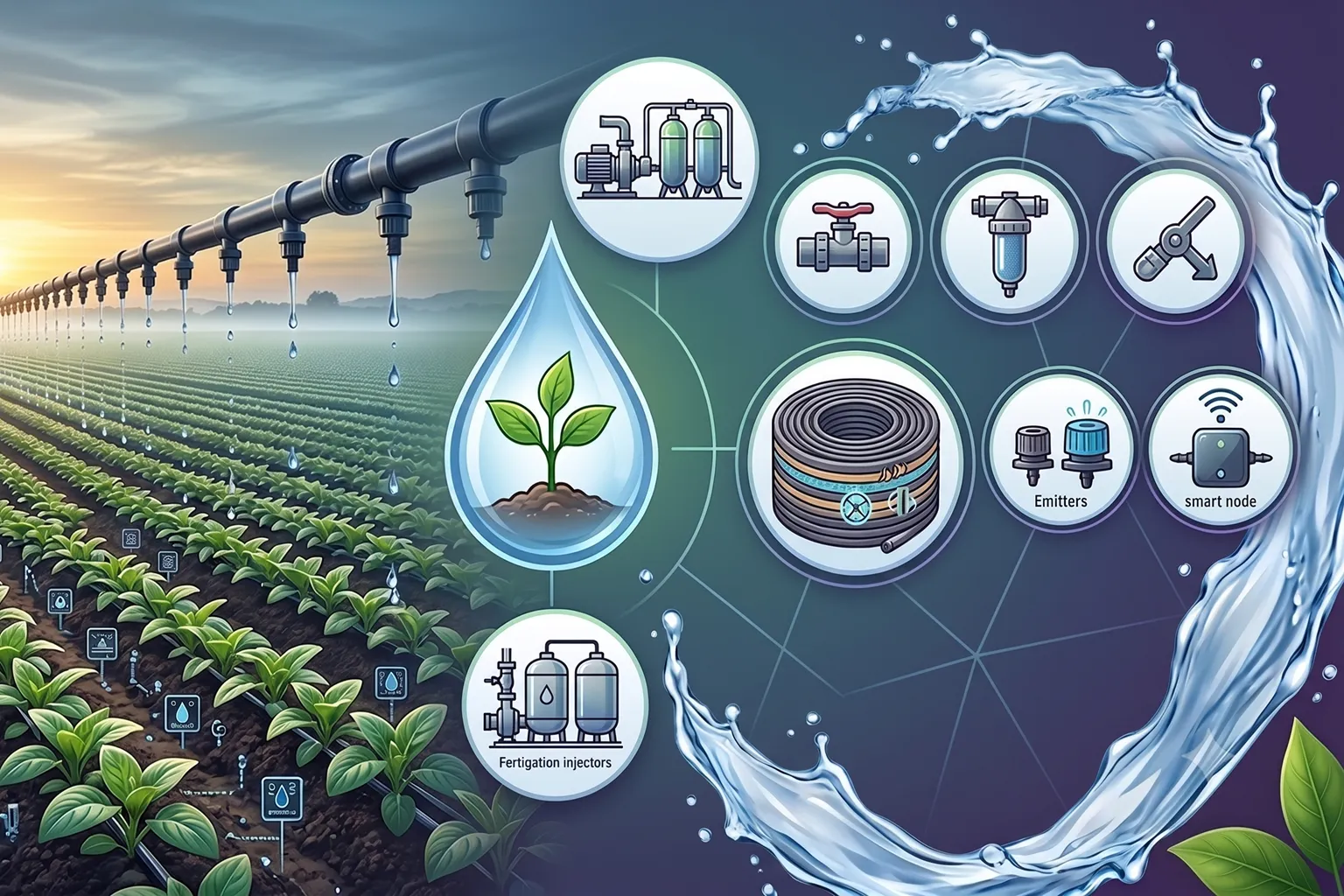
Drip Irrigation System Installation Guide 2026 with Performance Analysis
This automated method ensures water and essential nutrients are delivered directly to the root zone of each plant, eliminating evaporation and runoff, and revolutionizing resource management for commercial growers.
1. Core Components of an Industrial Drip System
An irrigation system of this magnitude requires a high-end engineering system to keep the water pressure even throughout a large field topography. Buying quality, long-lasting equipment allows your network to run through harsh conditions without getting clogged or pressured often.
A highly reliable configuration relies on specific, high-performance parts:
- Dripper lines & Emitters: Heavy-duty, pressure-compensating tubes which emit water at the same rate, no matter what changes in elevation occur from one point to the next over your acreage.
- Industrial Filtration Hubs: High-capacity media or disc filters that are used to remove physical sediment and organic debris before it can plug emitters downstream.
- Flow Control Fittings: UV-resistant Drip Irrigation Joiners, heavy-duty tees and secure end caps ensure complete system integrity even when pressure fluctuates.
Cooperating with a reputable drip irrigation system supplier, such as Payal Irrigation, the best drip irrigation system supplier in the industrial market, ensures that all elements are manufactured according to international standards in Agriculture, ranging from simple polypropylene fittings, to equally complex venturi fertigation systems.
2. The Heavy Lifters: Industrial Valves
For large-scale farming, sectional automation is achieved by using good-quality valving. Flow control for an entire zone is directly dependent on precision. That is the reason why commercial growers take extreme caution in obtaining their setups from only the best Drip Irrigation Valve Manufacturers.
Industrial irrigation requires special valves to safely control and operate large size water mains and sub-mains. The basic valve line includes:
Air Release Valves
Necessary for releasing trapped air during system startup and to avoid line collapses due to vacuum. Learn more about Air Release Valves.
PVC Flush Valves & Ball Valves
Strategically placed to permit manual or automated line flushing, removing fine silt. Learn about Drip Irrigation Ball Valves.
Lateral Cocks & Single-Piece Valves
Exact & localized control of individual crop rows and localized sub-zones. Discover Lateral Cocks.
Strong valves allow for hassle-free integration with automated smart controllers. This allows for different watering times to be programmed for large-scale operations, reducing risk of water hammer and structural damage to underground piping networks.
3. Financial Costs vs. Long-Term Water Efficiency Analysis
A conventional flood or sprinkler system is a less expensive capital investment initially, but they can be costly to operate over the long-term for a commercial farm.
The Cost Breakdown
The cost of an industrial setup is strongly influenced by crop spacing, acreage, filter requirements, and topography. Precision infrastructure investments are upfront, but returns vary greatly as the return of unmatched resource savings evolves over time.
The Efficiency Payoff
The efficiency of traditional overhead sprinklers is typically low (30%-60%) and has problems with drift and evaporation caused by high winds. By contrast, a professional industrial drip system can be more than 90% water efficient.
The ROI Matrix: The only way to achieve this is to deliver water slowly and steadily directly to the soil root zone, and the ROI Matrix is what makes that possible. At the same time, it reduces the electricity consumption of the pumps, reduces labor costs by using automated systems and increases the marketable crop yield by 50% to 70% due to the use of precision nutrient application (fertigation).
Frequently Asked Questions (FAQs)
Conclusion
Implementing an advanced Drip Irrigation System is a smart investment for a business and helps to protect commercial operations from increased water restrictions and input expenses. When industrial agribusinesses join forces with the finest drip irrigation system supplier, they can ensure that their investments in water distribution systems will yield high results for years to come, while enhancing natural resources.
